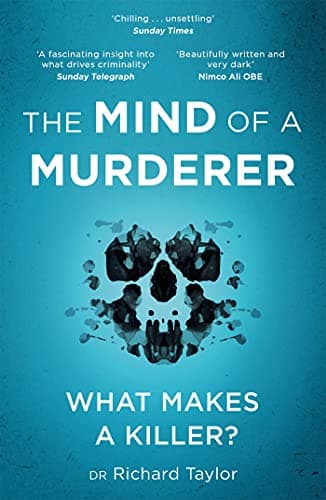
Richard Taylor is one of 350 or so forensic psychiatrists in Britain, their role falling at the intersection of psychiatry, aberrant behaviour and the law.
As well as writing the reports which form the basis of the court’s findings in respect of insanity or the partial defences, he and his colleagues, members of the Theseus team among them, are also responsible for making risk assessments about patients who may not yet have committed a serious crime, or who are awaiting release having committed one.
This is one of the most striking aspects of Richard’s description of his work: the sheer gravity of the day-to-day decisions the forensic psychiatrist is called upon to make. He candidly admits that psychiatrists are, after all, human and can from time to time get it wrong. But it is hard to conceive of a job that requires the making of more difficult ‘routine’ decisions, or decisions in which the consequence of error is potentially more dreadful.
Born in Singapore and having grown up in the South of England, Taylor trained as a doctor at UCL and was inspired to move into psychiatry, and then into forensic psychiatry, by some of the stabbing victims he treated in A&E as a junior doctor. In his three-decade career, Richard has worked on over 150 murder cases, both as an expert witness and as a treating forensic psychiatrist, dealing with perpetrators from all walks of life.
In this fascinating and sympathetic memoir Richard draws on some of the most tragic, horrific and illuminating of these cases – as well as a dark secret from his own family’s past – to explore, why people kill? Does committing a monstrous act make someone a monster? And, could any of us, in the wrong circumstances, become a killer?
The first chapter, dealing with sexual homicide, focuses on Anthony Hardy, the Camden Ripper. Taylor had assessed Hardy after a sex worker was found dead, supposedly of a heart attack, in his flat in 2002. Hardy went on to kill and dismember two more sex workers. The failings that led to these killings illustrate perfectly the stakes involved in the forensic psychiatrist’s job.
Murder for financial gain turns out to be surprisingly rare, and most of the killers who come Richard’s way have no real motives: people who are suffering from some form of psychosis; depressed mothers who kill their babies (among the most startling of his revelations is that the age group most likely to be the victim of homicide is children under twelve months); men who have abused their wives for years and finally escalate to homicide.
The narrative of Richard’s career and the cases on which he has worked is run through with observations about the provision of mental health services in the UK, frequency data regarding certain mental illnesses, types of murder and illuminating insights into strategies adopted by defence and prosecuting teams when cases reach trail. And as horrific as the case studies are, Richard manages to convey complex information clearly and succinctly, and in an accessible almost conversational tone. It is a gripping account of a fascinating career and the human condition itself.
The nature versus nurture question is a cental theme, and Richard confidently states that it all really comes down to the fact that most murderers are neither born nor made, but a mixture of both and there is substantial research to prove it. Nurture can significantly modify nature and vice versa. As far as Richard is concerned, under the right circumstances, anyone can actually become a killer.